
HOME
THE MISSION
CHANGED LIVES
TRIP STORIES
PHOTO ALBUM
EVENTS CALENDAR
HOW TO HELP
WHAT'S NEW
CONTACT US
LINKS & SPONSORS
STATUS UPDATES
THE AUCTION
ANNUAL RACE
HOUSE PROJECT
HAITIAN HEARTS

"Healing Haitian Children"

Dr. John Carroll arrives in Peoria on October 19th with Rose Myca Bain and Faustina Jacques. The two girls returned to Haiti on January 17, 2001 after having corrective heart surgury performed at the Children's Hospital of Illinois.

HAITIAN HEARTS IS A NON-PROFIT ORGANIZATION FOUNDED BY DR. JOHN CARROLL OF PEORIA, ILLINOIS, DEDICATED TO PROVIDING MEDICAL CARE IN HAITI AND IN THE U.S. TO HAITIAN CHILDREN WHO DO NOT HAVE ACCESS TO ADEQUATE CARE.

   Dr. John Carroll and all of the volunteers for Haitian Hearts thank you for your support in the past and pray that you choose to continue that support in the future.  Thanks to you, the Haitian Hearts Organization is alive and well.  We have sought out hospitals in nearby communities to provide services at a fair and reasonable cost.
   We will continue to raise the funds necessary to save more lives.  ALL of the funds raised go to benefit the people of Haiti.  Dr. Carroll has been bringing sick children and young adults to Central Illinois for medical care for the past 9 years, and that mission continues.

HAITIAN HEARTS
HEALING HAITI'S CHILDREN THROUGH A BRIDGE BETWEEN TWO WORLDS

  Consider a land where the sun shines warmly every day – a land where the peoples' language is like music to the stranger's ears.  But in this land, few young people become old people and children who get sick, stay sick.  Consider a land where broken hearts stay broken.
  Now consider another land – a land where fields of green stretch for miles.  A land of abundance and plenty, where people's hearts long to be touched by something true.  Where people yearn to give to something more than themselves – to give to those whose hearts are sick and broken.  There is a bridge that connects these two diverse worlds – a bridge called Haitian Hearts.
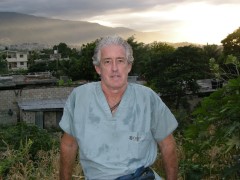
  For over 20 years, Peoria Physician Dr. John Carroll has been traveling to the Caribbean Island nation of Haiti.  He works in Haiti's hospitals and clinics going from the most sophisticated healthcare system ever to a nation with no medical resources.  He goes into a society near anarchy and collapse, responding to his vocation to be a "tiny instrument in the hands of God."
  "The medical needs in Haiti are so great, I was able to use what I'd been learning for such a long time in medical school and residency," Dr. Carroll explained, "and the Haitian people are so enjoyable to work with."
  The ninety minute flight from Miami is a trip into the third world where poverty has a firm grip on the Haitian people, most of whom live and support their families on an income of $350 a year.  At Hospital Lumiere, a rural mountain hospital, hundreds of patients and their families line up to wait for hours, sometimes days, for a chance at basic medical care.
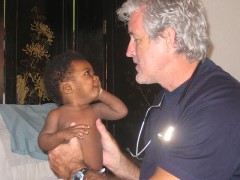
  As Dr. Carroll examines the Haitian children, he is listening for the sound of a murmur that tells him he is touching a child with a heart defect.  A hole or mechanical problem routinely repaired in the United States, is in Haiti a heart defect that brings a child a sentence of disability and slow death.
  As Dr. Carroll examines the children, he is in search of those with heart defects who are strong enough to make the trip to the United States for corrective heart surgery through the Haitian Hearts Program.  The parents of Haitian children fortunate enough to be selected for surgery, place their complete trust in Dr. Carroll and others they've never met for the chance their child may survive surgery and return to them with a new chance at life.
  Through the remarkable Haitian Hearts program, volunteer families in Peoria host the Haitian children in their homes.  For weeks and months, households in the Midwest ring with the lilting Creole names of Haitian children, and during that time a profound change happens.  These kids, here to have their physical hearts repaired, touch the hearts of hundreds of others who are in turn healed.  A bridge is built across races, languages, and lands.  The barriers, so real in everyday life, dissolve in the light of love – love given, love received and love returned.
  "The host families get a great look at themselves – an introspective look at their families," Dr. Carroll explained.  "I really believe that they understand how much they have when they look at one of these little children come with a tiny little knapsack with maybe one dress, no toys, and the American family realizes how much we really have as a culture."
  At Children's Hospital of Illinois at OSF Saint Francis Medical Center in Peoria, doctors donate their time and talent, and Haitian Hearts are mended.  The mission of the hospital's Sisters of the Third Order of Saint Francis has always been helping the poor.  Through their generosity, these children from the poorest country in the Western Hemisphere undergo surgery in one of the best pediatric heart surgery programs in the United States.
  To share the financial burden on Children's Hospital of Illinois and to accept more children for surgery, Dr. Carroll and others formed Haitian Hearts – an all volunteer group whose sole purpose is to deal with the logistics of bringing children to the United States for life-saving surgery, and to raise funds for their medical care.
  "The dollars that are donated to Haitian Hearts go directly to Children's Hospital of Illinois/Haitian Hearts, so that money is allocated for Haitian Heart surgery.  That money stays right in the hospital and helps pay for the direct costs for that child's care," Dr. Carroll explained.  " I guess I'm most amazed when I'm in the operating room at Saint Francis and a child is on the operating table, and I look down and I see all the wonderful care – the expedient care that the child is getting that he would not have received in Haiti.  I'm constantly flashing back to the original exam that I did on the child in Haiti, and comparing the two different environments."
  "it makes me feel quite good to see a Haitian child be able to walk out of intensive care with a normal gait, not short of breath, not blue," Dr. Carroll said.  "It makes me feel that I'm doing what I should be doing with what I've been given in my life.  As a group – Haitian Hearts, I think we try to do just that.  We try to keep it as simple as possible, keeping the Haitian child the central focus.  When we come to Haiti, or even in the United States, we're not worried about all eight million Haitians, we're just concerned about the Haitian child in front of us, and the details of care of that Haitian child"

This article was adapted from a video script which was written by Jeff Cunningham of VideoWorks at WILL-TV, Urbana, Illinois.

COUNTER